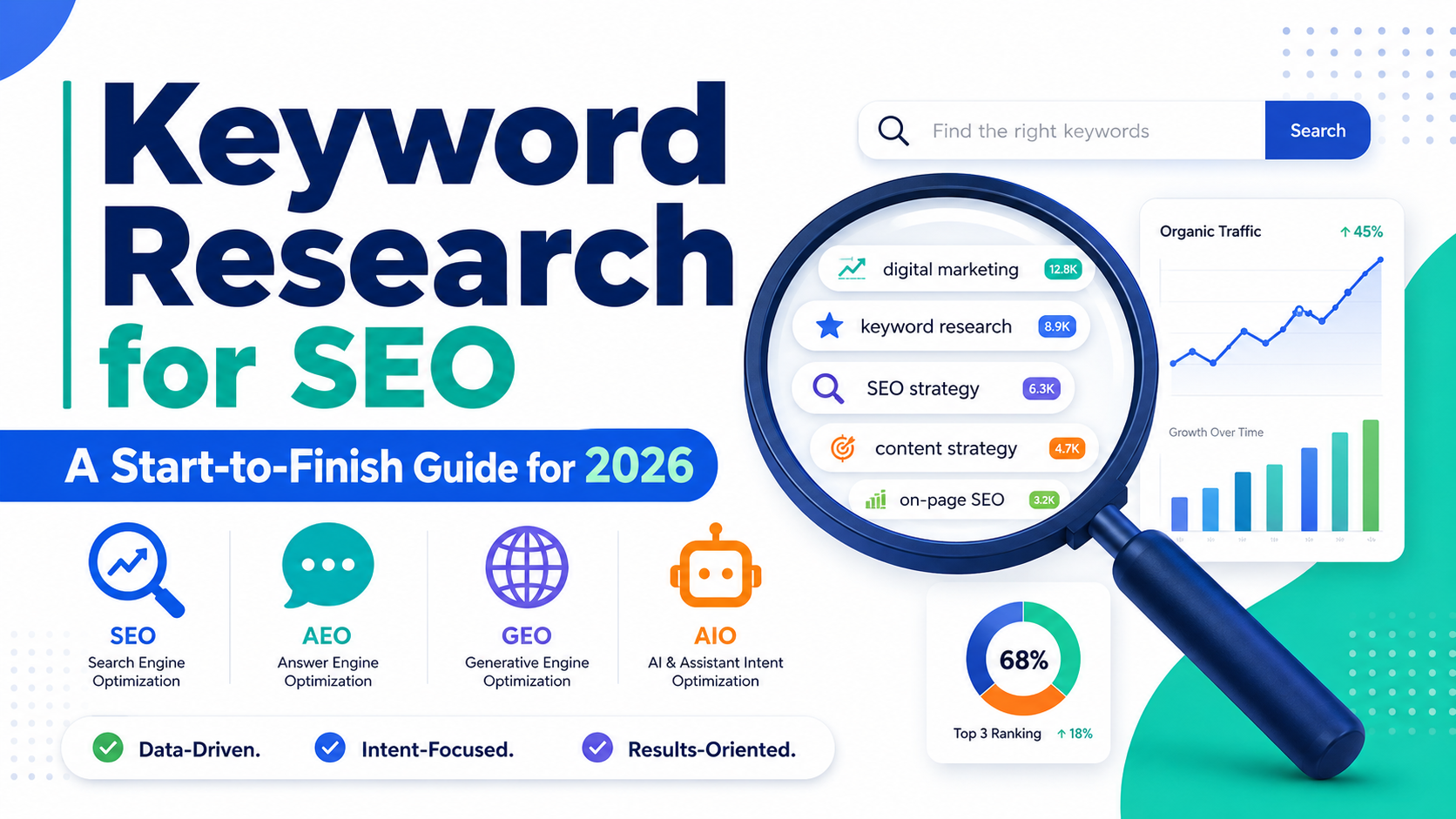
Keyword research still sits at the center of any organic strategy, but the tools, ranking signals, and distribution channels have shifted since the early days of SEO. In 2026 you need to think beyond raw search volume and focus on intent, answer engines, and AI-driven surfaces. This guide walks you through a practical, start-to-finish process you can use whether you’re building new content or auditing an existing site.
What changed in keyword research by 2026 (short version)
Search is no longer just pages listed in SERPs. Answers are surfaced in generative responses, assistant snippets, knowledge panels, and voice. Major changes to account for:
- Search Generative Experiences (SGE) and AI assistants extract concise answers from multiple sources.
- Zero-click and direct answer traffic matters — impressions and clicks behave differently.
- Intent understanding is deeper: queries are grouped by user goal rather than exact phrasing.
- Ranking signals now reward structured content, clear answers, and trustworthy sources for assistant use.
Key terms: SEO vs AEO vs GEO vs AIO (what each means in 2026)
These four acronyms describe related but distinct optimization goals you should consider when planning keywords.
SEO (Search Engine Optimization)
Traditional SEO focuses on helping pages rank in search engine result pages (SERPs). Tactics include content relevance, backlinks, on-page optimization, page experience, and structured data. SEO remains essential for organic visibility, especially for higher-click SERPs.
AEO (Answer Engine Optimization)
AEO aims to get your content used as direct answers—featured snippets, knowledge panels, quick answers, and short-form responses inside search or assistant UIs. These results often produce impressions without clicks, so AEO emphasizes concise, authoritative answers and clearly structured content (bullet lists, short paragraphs, Q&A sections, and schema).
GEO (Generative Engine Optimization)
GEO refers to optimizing content so it’s likely to be surfaced or cited by generative AI engines and LLM-based assistants. Considerations include authoritative sourcing, clarity, machine-readable structure, and content that summarizes and cites credible references. GEO overlaps with AEO but focuses on the needs of LLMs that synthesize across sources rather than returning a single snippet.
AIO (AI/Assistant Intent Optimization)
AIO is a broader practice of shaping content and signals to satisfy AI assistants’ interpretation of user intent. AIO blends SEO, AEO, and GEO tactics and adds attention to promptability (how well content answers compact prompts), schema, canonicalization, and source trust signals. In short: if you want your brand to appear in AI-driven answers, prioritize AIO.
All four approaches overlap. Your strategy should prioritize them based on business goals—traffic, conversions, brand presence in assistant answers, or local discovery.
Start-to-finish keyword research process (step-by-step)
This workflow goes from goal definition to prioritization and tracking. Treat it as an iterative loop — revisit every quarter or when market conditions change.
1) Define goals and success metrics
Before gathering keywords decide what you want: increase organic traffic, improve conversions, capture voice search queries, own answer slots, or grow branded mention inside assistants. Match goals to metrics: clicks, conversions, assisted conversions, impressions in GSC, zero-click share, or citations in AI answers (where available).
2) Identify audience intent and target topics
Map the user journeys relevant to your business. Typical macro-intent buckets:
- Know: research, definitions, comparisons.
- Do: transactional (buy, subscribe, sign up).
- Go: local intent (near me, hours, directions).
- Ask/Assist: queries suited to voice or assistant answers.
List the core topics you own or want to target. These become seed topics for keyword discovery.
3) Create seed keyword lists
Start with simple seeds: product names, topics, common questions, use cases, pain points, competitor brands, and pages you want to improve. Use internal sources too: search site logs, support tickets, chat transcripts, and sales FAQs — these reveal the language your audience uses.
4) Expand with tools and AI (idea generation)
Use a mix of data tools and LLM brainstorming:
- Classic tools: Google Keyword Planner, Google Trends, Bing Webmaster Tools.
- SEO platforms: Ahrefs, Semrush, Moz for volume and difficulty estimates.
- Competitor gap analysis: find keywords competitors rank for but you don’t.
- LLM idea generation: ask an AI to expand seed topics into questions and long-tail phrases — then verify volumes and intent with data tools.
Always verify AI-generated ideas against real search data before investing in content.
5) Analyze SERPs and assistant behavior
For each candidate keyword check the current SERP. Important signals:
- Are there featured snippets, knowledge panels, or SGE cards? (AEO/GEO opportunities)
- Are top results authoritative or user-generated? How long are the top pages?
- Is intent informational, transactional, or local?
- Do you see heavy personalization or localized listings?
Document the dominant content format (listicle, how-to, product page, local listing) — you’ll need to match or improve on that format.
6) Estimate value: volume, difficulty, and ROI
Gather data for each keyword:
- Search volume (monthly or trend)
- Keyword difficulty / competition
- Estimated click-through rate (consider SERP features that reduce clicks)
- Commercial intent and average conversion value or CPC (optional)
Score or rank keywords by expected ROI. A simple formula:
Priority score = (Relevance × Volume × Click Potential) ÷ Difficulty
Relevance = how closely the query aligns with your offer (1–5). Click Potential adjusts for zero-click SERPs. Difficulty comes from your tools or an internal estimate relative to competitors.
7) Cluster keywords and map to content
Group related queries into clusters around a primary topic or intent. Use semantic clustering (by meaning) rather than just exact words. Each cluster should map to:
- A primary landing page (pillar) — the best place to capture broad intent.
- Supporting pages or modular content (FAQs, blog posts, product pages) that target narrower queries and long-tail variations.
Clustering helps prevent keyword cannibalization and creates a better internal linking structure — both important for SEO and for being cited by AI assistants.
8) Optimize format for the outcome: SEO, AEO, GEO, or AIO
Decide what success looks like for each cluster and format content accordingly:
- If you want clicks and rankings, prioritize comprehensive pages, good headings, internal links, and conversion elements (SEO).
- If you want to win quick answers or snippets, provide crisp, concise answers near the top of the page, use lists, tables, and FAQ schema (AEO).
- If you want to be cited by generative engines, use clear summaries, authoritative citations, and machine-readable metadata; avoid ambiguous phrasing (GEO).
- For assistant-first visibility, make content promptable: short answer blocks, structured data, clear source attribution, and easily consumable facts (AIO).
9) Create the content with quality and structure in mind
Best practices in 2026 still include accuracy, readability, and helpfulness. Additional priorities:
- Lead with a clear answer for question queries.
- Use H2/H3 structure that mirrors user questions and subtopics.
- Include data, examples, and sources for credibility.
- Implement relevant schema: FAQ, HowTo, Product, LocalBusiness, and speakable where appropriate.
- Add short metadata snippets (TL;DR boxes) that assistants can easily extract.
10) Publish, monitor, and iterate
After publishing, measure performance not just by rankings but by clicks, impressions, conversion rate, and assistant citations if available. Key tools for measurement:
- Google Search Console for impressions, clicks, and queries.
- Analytics for conversions and behavior.
- Rank trackers for high-priority keywords (expect noise from personalization).
- Platform-specific reports for voice or assistant surfaces if providers offer them.
Iterate on pages that get impressions but low clicks, and on pages that are cited by assistants but don’t drive conversions.
Practical tactics and checks for 2026
Prioritize questions and micro-moments
People increasingly ask multi-step queries or voice questions. Map content to micro-moments: “I want to know,” “I want to go,” “I want to do,” and “I want to buy.” Provide bite-sized answers for assistants and deeper pages for readers who want more.
Leverage schema and structured data
Structured data helps machines understand your content. Use schema to mark up FAQs, steps, product info, pricing, and official data. Correct schema increases the odds of appearing in AEO/GEO outputs.
Think in answers, not just keywords
Create content that answers the question fully and succinctly before expanding. Assistants prefer clear, sourced answers. A concise lead followed by optional depth is a reliable pattern.
Use embeddings and semantic clustering
Embedding-based clustering groups keywords by meaning. This reduces cannibalization and helps create content clusters that reflect how assistants and search engines semantically link topics.
Balance short-term wins and long-term plays
Target some low-difficulty, high-intent queries for quick gains and invest in pillar content to build authority over time. For AEO/GEO visibility, maintain factual accuracy and update content frequently.
Measuring success: what to track
Standard metrics remain useful but add assistant-focused observations:
- Clicks and impressions (Google Search Console).
- Click-through rate by query (optimize meta titles and descriptions to improve CTR).
- Conversions and micro-conversions (content downloads, signups).
- Pages that generate impressions but few clicks — good candidates for AEO format changes.
- Mentions or citations in AI assistant outputs where you can track them (brand mentions, direct answers).
Common mistakes and how to avoid them
- Chasing only high-volume keywords — volume without intent yields low ROI.
- Ignoring SERP features — if the SERP favors snippets, plan to appear there rather than outrank long pages.
- Over-optimizing a single page for many distinct intents — split content by intent when necessary.
- Relying solely on LLM suggestions without verifying search demand and competition.
- Neglecting local signals for “near me” and local queries — use local schema, Google Business Profile, and local landing pages.
Tools and resources to use (practical list)
- Google Search Console and Google Trends — demand and performance data.
- Ahrefs, Semrush, Moz, or similar — volume, difficulty, competitor research.
- Rank trackers that support local and device-specific tracking.
- LLM tools for brainstorming (use only for ideation; verify with data).
- Site search and support logs — for real user language.
- Embedding libraries or platforms for semantic clustering (if you have the technical resources).
Who should use this approach — and who should skip it
Use this guide if you:
- Manage content for websites that rely on organic search, local discovery, or assistant visibility.
- Want a repeatable process for topic selection, content mapping, and measurement.
- Need to balance traditional ranking with visibility inside AI-driven answers.
Skip or simplify this process if you:
- Operate a tiny site with a handful of pages and immediate needs — focus on a few high-value pages first.
- Have no organic channel goals and rely entirely on paid or direct traffic.
Checklist: Quick action plan (first 30 days)
- Define 3–5 business goals tied to organic outcomes.
- Pull top 100 queries from Search Console; categorize by intent.
- Create seed list of 50–200 keywords from internal data and competitor gaps.
- Cluster keywords into topic groups and map each to a target URL type.
- Prioritize 5–10 content pieces to create or update using the priority score formula.
- Implement schema for high-priority pages and publish improved content.
- Set up dashboards to track impressions, clicks, CTR, and conversions by topic.
Final thoughts
Keyword research in 2026 blends traditional SEO rigor with new requirements for assistant and generative engine visibility. The principle hasn’t changed: understand your users’ intent and build content that satisfies it. The practice has evolved — you must design content for both human readers and machine consumers. Prioritize clarity, structure, and trustworthiness, and use a data-driven cycle of discovery, publish, measure, and iterate.
Start small, iterate quickly, and treat AEO/GEO/AIO as complements to SEO — not replacements. That balanced approach will keep your content discoverable whether users search on a page, ask an assistant, or hear an answer via voice.
More from The Affiliate Digest
-
Tube Claw AI review: Features, pricing, is it legit or a scam?
Tube Claw AI promises an all-in-one AI toolkit for faceless YouTube channels: scripts, voices, avatars, SEO and uploads.…
-
Brett Rutecky’s Affiliate Store Review
Affiliate Store is a low-cost, no-code AI assistant for creating a simple affiliate storefront. It can generate product…
-
How to Get Traffic for Affiliate Marketing: A Beginner’s Step‑by‑Step Guide
Practical, step-by-step methods to get targeted traffic for affiliate marketing — free and paid options, SEO and content…
-
Aigency Valet Review — What Joshua Zamora’s Service Promises and Who It’s Best For
Aigency Valet is a marketing/agency support product marketed by Joshua Zamora that promises systems and assets to help…
-
Vidicom review: AI product videos for e-commerce (2026)
Vidicom is an AI video generator that creates studio-style product videos from a product URL. It’s designed for…