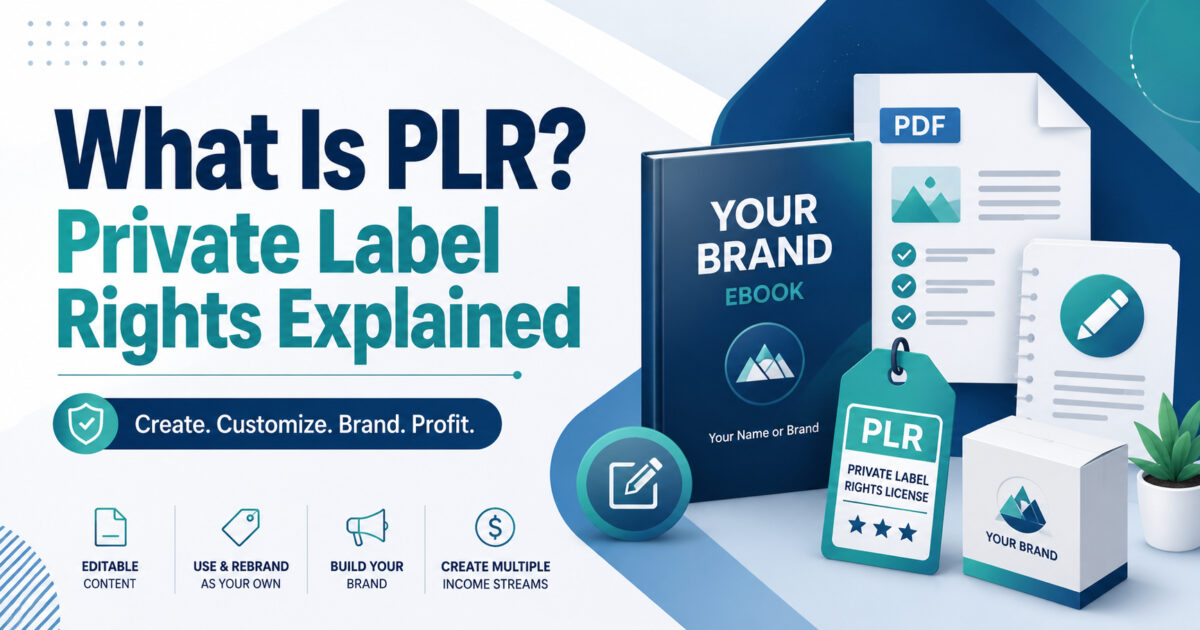
Direct answer: PLR (Private Label Rights) are digital products—ebooks, articles, courses, templates, printables, videos—sold with a license that lets you edit, rebrand, and resell the material as your own. PLR can save huge time, but it only works if you customize and improve the content; uploading generic PLR unchanged is risky for both SEO and reputation.
- PLR = buy, edit, rebrand, resell (usually allowed).
- Best used as raw material—customize heavily for SEO and trust.
- Watch license terms, image rights, and platform rules (KDP, marketplaces).
What this means
PLR gives you pre-written or pre-made digital assets plus permissions that go beyond simple use. Instead of starting from scratch, you get a product you can adapt and monetize quickly. That makes PLR attractive to bloggers, coaches, affiliate marketers, and small businesses who need done-for-you content. But PLR is not a shortcut to passive income: the winners add unique value, and the losers repost generic files that match dozens of other sellers.
How PLR works (types and rights)
PLR products are available in many formats and quality levels. Common PLR digital products include:
- PLR ebooks — paperback-style files, usually Word and PDF.
- PLR articles — batches of blog posts or short content pieces.
- PLR courses — slide decks, video scripts, or full course modules.
- PLR templates — email, landing page, social graphic templates.
- PLR printables — planners, checklists, worksheets.
- PLR videos — stock or narrated videos with rights to edit.
Licenses vary, but the typical PLR license allows you to:
- Edit the content (text, graphics, layout).
- Put your name on it or brand it as yours.
- Resell the product or give it away as a lead magnet (unless restricted).
Common license variations you’ll see:
- PLR (Private Label Rights): usually the most flexible—edit, rebrand, resell.
- MRR (Master Resale Rights): you can resell the product but often cannot claim authorship or modify it.
- Resale Rights (RR): basic permission to resell without modification rights.
- White label: similar to PLR but sometimes sold with more brand-friendly assets; check exclusivity.
Is PLR legal?
Yes—PLR is legal when the seller legitimately owns the content and issues rights. The legal risk comes if the seller resells copied or copyrighted material they don’t own, or if the PLR includes images or media without proper commercial rights. Always verify the seller’s reputation and that the license explicitly grants the uses you need.
Step-by-step guide: How to use PLR the smart way
Follow these steps to turn PLR into a unique, monetizable asset instead of a duplicate product everyone else offers.
- Choose PLR carefully. Look for reputable sellers, recent publishing dates, and complete file packages (editable source files, images, covers, metadata). Avoid overly generic topic titles or content that reads like a template.
- Read the license fully. Check whether you can edit, claim authorship, resell, include in paid products, or use images commercially. Note platform restrictions (some sellers forbid listing on certain marketplaces).
- Run an initial quality check. Scan for obvious errors, outdated facts, or thin content. Poor grammar and out-of-date stats are red flags.
- Create a unique title and cover. For ebooks and courses, a new title and cover immediately differentiate the product in searches and marketplaces.
- Rewrite headlines and intros. Start every PLR piece with an original introduction and reorganized headings so the structure looks fresh to readers and search engines.
- Add original content. Insert at least 20–50% new material: examples, case studies, actionable checklists, or a new chapter. For short posts, consider full rewrites.
- Replace or license images. Don’t rely on included images unless the license covers commercial use. Prefer your own graphics or licensed stock photos.
- Optimize for SEO. Update metadata, write a new meta description, use original H1/H2s, and ensure content targets a clear keyword. Use plagiarism tools to check uniqueness before publishing.
- Brand and package for your channel. Tailor the format to where you’ll sell—Etsy printable, Gumroad digital download, Shopify product, email lead magnet, or members’ course.
- Promote with added value. Launch with bonus resources (worksheets, video summaries, email sequences) to justify pricing and stand out from other sellers of the same PLR.
- New title + cover
- Unique intro + 30–50% new content
- Replace images with licensed assets
- SEO tuning: headings, meta description, internal links
Common mistakes (and how to avoid them)
- Publishing PLR unchanged. Fastest route to duplicate content and product saturation. Always edit.
- Assuming all images are safe. Many PLR packs reuse stock images without commercial permission—replace them.
- Ignoring license fine print. Some PLR restricts resale on specific platforms or disallows bundling—read terms.
- Using PLR for keyword-stuffed SEO posts. Light edits won’t outrank originals; rewrite for intent and add unique insights.
- Overpricing a generic PLR product. Compete on value: bundle, add support, or convert to course to justify price.
Practical monetization ideas (how to make money with PLR)
- Lead magnets: Rebrand a PLR ebook or checklist to capture email subscribers. Free lead magnets are one of the safest uses.
- Low-ticket digital products: Sell a polished PLR ebook or printable for $7–$27 on Gumroad or Shopify.
- Upsell to courses/coaching: Expand PLR course modules into video lessons and offer a paid course or coaching add-on.
- Membership content: Use PLR to stock a paid membership with weekly content—add member-only commentary to each item.
- Bundles and value-adds: Combine multiple PLR items, add templates or worksheets, and position it as a toolkit.
- Resell with extras: Offer the PLR plus customization or done-for-you services (e.g., customized funnel copy for clients).
Where can I sell PLR products?
Platform rules vary.
- Shopify / WooCommerce: Good for direct sales. You control the product pages and customer experience.
- Gumroad / Payhip: Simple distribution for digital downloads; seller has flexibility.
- Etsy: Allows digital downloads, but the marketplace favors unique handcrafted or designer items—generic PLR may not convert well.
- Amazon KDP: High risk. KDP disallows content that is not original or that is available elsewhere without significant added value. Heavy rewriting and original content are required; check KDP’s content guidelines.
PLR vs MRR vs Resale vs White label — quick differences
| Right type | Can edit? | Claim authorship? | Resell? |
|---|---|---|---|
| PLR | Yes | Usually yes | Yes |
| MRR (Master Resale Rights) | Sometimes limited | Usually no | Yes |
| Resale Rights (RR) | No | No | Yes |
| White label | Often yes | Yes | Yes (depends on license) |
Is PLR content bad for SEO? Can PLR rank?
PLR content itself isn’t inherently bad, but identical content published across many sites is a duplicate content problem. Search engines try to choose the most authoritative or original source, and identical PLR posts are unlikely to rank well. To use PLR successfully for SEO:
- Rewrite heavily—unique headlines, subheads, and a new introduction.
- Add original examples, updated statistics, and internal links to your site.
- Merge multiple PLR articles into a longer, comprehensive guide that offers unique value.
- Run plagiarism checks (Copyscape, Siteliner, or other tools) before publishing.
How much should you rewrite?
There’s no fixed percentage that guarantees safety, but aim for meaningful transformation: change the structure, add substantial original content (20–50% or more), and ensure your voice and examples are unique. For short posts, consider near-complete rewrites. For long-form ebooks, adding new chapters, case studies, and proprietary templates goes a long way.
How to rebrand PLR products (practical tips)
- Give it a new name and subtitle that targets a specific audience.
- Create a custom cover and promotional graphics.
- Add an original foreword or author bio that positions you as the expert.
- Include new actionable steps, worksheets, or a quick-start checklist.
- Bundle with bonuses: email swipe files, social graphics, or a mini-course.
What to look for in a PLR license
- Can you edit the content and claim authorship?
- Are you allowed to resell and on which platforms?
- Are images and multimedia cleared for commercial use?
- Are there limitations on bundling, membership use, or adding bonuses?
- Does the seller provide editable source files (Word, PSD, PPTX)?
- Are there revocation or refund clauses that affect your use?
Risks of using PLR
- Duplicate content—SEO and marketplace problems if you publish unchanged material.
- Poor-quality PLR can hurt your brand if you sell low-value products.
- Hidden image or media rights that trigger copyright complaints.
- Marketplace policy violations (especially KDP) that can lead to takedowns.
- Saturated markets where dozens of sellers offer the same product.
Recommended next steps (practical plan for beginners)
- Start with a small PLR purchase (one ebook or small bundle) from a reputable seller.
- Read the license and test the files—confirm editable formats and image rights.
- Rebrand: new cover, new title, and a unique intro—use it as a lead magnet first to build an email list.
- Measure results: track opt-in rates, sales conversion, and feedback. If it performs, scale with more customization and bundles.
- Build a content pipeline: use PLR as the research and outline base, but add original commentary and case studies.
Pros and cons of using PLR
- Pros:
- Saves time and speeds product creation.
- Cost-effective compared with hiring a writer or designer.
- Good source of ideas, outlines, and templates.
- Cons:
- Often low-quality or overused unless customized.
- Possible duplicate-content issues for SEO.
- Image and rights issues if not reviewed carefully.
FAQ
Can I edit PLR content?
Usually yes—editing is one of the main benefits of PLR. Confirm by reading the license. If you plan to claim authorship or republish in different formats, ensure the license explicitly allows that.
Can I put my name on PLR content?
Most PLR licenses allow you to claim authorship, but check terms. Some license types (like simple resale rights) do not permit claiming authorship.
Can I sell PLR ebooks on Etsy, Gumroad, Shopify, or Amazon KDP?
Gumroad and Shopify are straightforward for selling digital PLR products if you own the rights. Etsy allows digital downloads but tends to favor original handcrafted or designer items—conversion can be low for generic PLR. Amazon KDP is the most restrictive; KDP has policies against low-quality or duplicated content and may reject or remove entries that don’t offer sufficient unique value. For KDP, heavy rewriting and original supplemental content are essential.
Is PLR the same as MRR?
No. PLR usually allows editing and claiming authorship. MRR (Master Resale Rights) allows you to resell the product and sometimes resell the resell rights, but often with more restrictions on editing or claiming authorship.
How do I make PLR content unique?
Rewrite headings and intros, add proprietary examples or case studies, update facts and statistics, include original images or worksheets, and change the product’s structure. The goal is to make the asset meaningful and valuable to your audience.
How do I use PLR for email marketing and affiliate marketing?
Turn PLR into lead magnets and email course sequences, adding affiliate links where appropriate (and compliant). For affiliate marketing, customize content to match the products you promote and include honest recommendations and disclosures.
What are the best PLR niches?
Evergreen niches tend to perform best: productivity, marketing, health basics, personal finance, business skills, coaching tools, and content creation. Match the niche to your audience and add expertise to stand out.
Disclosure
This article explains PLR and how to use it. It does not promote a specific vendor. If you use PLR, always review the seller’s license and verify image/media rights. Affiliate Digest recommends customizing PLR before publishing and using plagiarism checks to protect SEO and reputation.
Final recommendation: Treat PLR as raw material, not a finished product. Buy selectively, read licenses, and invest time in rewriting, rebranding, and adding original value—then PLR can be a cost-effective way to scale content and products.
More from The Affiliate Digest
-
Tube Claw AI review: Features, pricing, is it legit or a scam?
Tube Claw AI promises an all-in-one AI toolkit for faceless YouTube channels: scripts, voices, avatars, SEO and uploads.…
-
Brett Rutecky’s Affiliate Store Review
Affiliate Store is a low-cost, no-code AI assistant for creating a simple affiliate storefront. It can generate product…
-
How to Get Traffic for Affiliate Marketing: A Beginner’s Step‑by‑Step Guide
Practical, step-by-step methods to get targeted traffic for affiliate marketing — free and paid options, SEO and content…
-
Aigency Valet Review — What Joshua Zamora’s Service Promises and Who It’s Best For
Aigency Valet is a marketing/agency support product marketed by Joshua Zamora that promises systems and assets to help…
-
Vidicom review: AI product videos for e-commerce (2026)
Vidicom is an AI video generator that creates studio-style product videos from a product URL. It’s designed for…