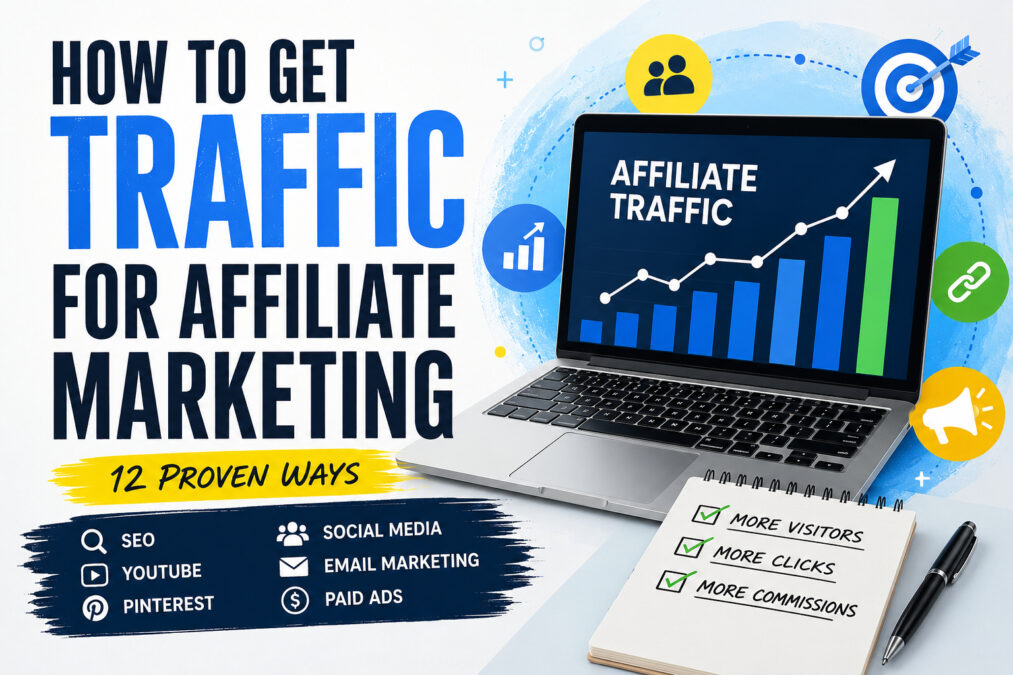
- Start with one reliable traffic source (SEO, YouTube, Pinterest, or social).
- Create content that solves a specific audience problem and matches buyer intent.
- Build an email list, track clicks, and scale with paid ads once you validate offers.
Direct Answer
How to get traffic for affiliate marketing: pick one dependable channel, create helpful content aimed at buyer intent, optimize for search or platform discovery, and promote the affiliate offer where it naturally fits. Beginners should focus on organic channels like SEO, YouTube, Pinterest, or niche social communities first; use email to capture visitors and paid ads only after you’ve validated the funnel.
What This Means
That short answer lays out three practical points: (1) don’t chase every platform — specialize, (2) content must solve a specific user need (not just hype a product), and (3) measure and iterate. Traffic that converts is targeted: people searching to buy or researching solutions. Random views or vanity metrics rarely make sales.
How It Works (Overview of Traffic Types)
Affiliate traffic falls into several categories. Each has strengths and tradeoffs; match the channel to your niche and the buyer’s journey.
Organic (Free) Traffic
- Search (SEO) — Traffic from Google and other search engines. Best for buyer-intent keywords and product reviews. Requires consistent content and on-page/off-page SEO.
- YouTube — Video search and discovery. Works well for demo, review, and tutorial content. Videos can rank in search and Google results.
- Pinterest — Visual discovery platform that acts like a search engine for many niches (home, DIY, fashion, software screenshots, recipes).
- Social communities — Reddit, Quora, niche forums, and Facebook groups. Good for answering specific questions; be careful with affiliate link policies.
Paid Traffic
- Search Ads (Google/Bing) — Fast, intent-driven, but usually costlier for competitive affiliate niches.
- Social Ads (Facebook, Instagram, TikTok) — Good for interest-based targeting and cold audiences; best when you have a strong landing page or lead magnet.
- Native and Content Networks — Taboola, Outbrain, and similar; can work for content-led funnels.
Owned Channels
- Email — Owned, repeatable traffic and conversions. Highest ROI over time if you build a quality list.
- Your website/blog — Best long-term control: host content, capture leads, and build authority.
Step‑by‑Step Guide: How Beginners Get Their First Affiliate Traffic
This section is a practical playbook you can follow from zero to consistent traffic.
Step 1 — Choose a niche and one traffic source
- Pick a niche you can create content for consistently. Avoid ultra-broad niches; specificity helps you target buyer intent.
- Choose one traffic channel to start — SEO (blog), YouTube (video), Pinterest (visual posts), or a single social platform (TikTok/Instagram). Focus reduces learning time and improves results.
Step 2 — Pick affiliate offers that fit the audience
- Find offers with clear buyer intent (e.g., “best [product] for [use case]”, “buy [product]”).
- Prefer reputable programs with solid product pages — high refunds or poor UX kills conversions.
- Check platform rules for direct affiliate linking (some platforms ban direct links or require disclosure).
Step 3 — Do keyword and audience research
Whether you’re making articles, videos, or pins, your content should be found by searches or feeds. Use these methods:
- Seed keywords: Start with product names and problems your audience has.
- Keyword tools: Free (Google Autocomplete, AnswerThePublic, YouTube autocomplete) and paid (Ahrefs, SEMrush, Keywords Everywhere) help find long-tail buyer-intent keywords like “best [product] for [problem]”.
- Search intent: Target transactional and commercial investigation queries for affiliate sales (“buy”, “best”, “vs”, “review”).
Step 4 — Create a content plan and cluster
Build topical clusters: a pillar page (or main video) that covers the topic broadly, plus supporting content targeting specific long-tail queries. This helps search engines and platforms understand your expertise and keeps visitors in your funnel.
- Pillar: “Best [product category] for [audience] 2026 — full guide”
- Supporting posts/videos: detailed reviews, comparisons, tutorials, and buyer‑intent FAQs.
- Internal linking: connect supporting pieces to the pillar and each other to share authority and guide clicks to your affiliate links.
Step 5 — Optimize content for conversions
- Match content to intent: If someone searches “best X under $100,” deliver that exact info and include a clear CTA.
- Use clear CTAs and multiple affiliate placements: in-text links, buttons, and comparison boxes.
- Include honest pros/cons, alternatives, and buying guidance — builds trust and improves conversions.
Step 6 — Publish, promote, and capture emails
- Publish on your chosen platform, then promote the content within the same platform (YouTube tags, Pinterest descriptions, social posts) and across your other channels.
- Add an email opt-in: a short checklist, buying guide PDF, or coupon collection. Email is how you turn one-time traffic into repeat visitors and higher long-term conversions.
Step 7 — Track, measure, and iterate
- Use UTM-tagged links, Google Analytics, platform analytics, and your affiliate dashboard to monitor clicks and conversions.
- Track metrics: traffic volume, CTR to affiliate links, conversion rate, and revenue per visitor. Small changes (CTA wording, image, or headline) can improve results noticeably.
How Long Until You See Traffic?
Paid traffic can start immediately. Organic channels: YouTube or Pinterest may deliver visible traffic in weeks; SEO usually takes 3–9 months for consistent search traffic on a new site. Frequency and quality matter: publish consistently, optimize, and build backlinks/community signals.
Free vs Paid Traffic: When to Use Each
Start free to validate offers and messaging. If you have a proven funnel with profitable conversions, use paid ads to scale. Paid traffic requires good creatives, tracking, and an offer with predictable ROI.
Best Free Traffic Sources for Affiliate Marketing (and When to Use Them)
- SEO (Organic Search) — Best for review/comparison content and long-term growth. Good if you can publish and optimize blog posts.
- YouTube — Ideal for product demos, unboxings, and step-by-step tutorials. Visual proof often increases buyers’ confidence.
- Pinterest — Works well for visual niches and evergreen content. Pins can drive surprisingly consistent traffic over months.
- Social (TikTok, Instagram, Facebook Groups) — Great for audience building, fast testing, and niches where short video or community interaction fits.
- Forums/Communities (Reddit, Quora, niche forums) — Use to answer high-value questions and link to helpful resources (respect community rules).
How to Drive Traffic Directly to Affiliate Links (Without a Website)
You can promote affiliate links without a website, but there are tradeoffs: less control, platform policies, and sometimes lower trust. Common approaches:
- YouTube — Place affiliate links in video descriptions and pin them in comments. Provide strong value in the video and disclose affiliate relationships.
- Pinterest — Some programs allow direct affiliate links in pins (check current Pinterest policy). Alternatively link to a landing page or content hub.
- Instagram/TikTok — Use bio links, link-in-bio tools, or short landing pages; some platforms restrict direct commercial links in captions.
- Medium, LinkedIn, or Quora — Post helpful content and link to offers when allowed; disclosure is still required.
Tip: Even without a full website, create a simple landing page or link hub (Carrd, Linktree, simple WordPress) to host disclosures and more context — this improves conversion and trust.
How to Get Organic Traffic to an Affiliate Website (SEO Checklist)
- Keyword research: target buyer-intent long-tail keywords first.
- On-page SEO: optimized titles, meta descriptions, header structure, clear CTAs, and descriptive alt text for images.
- Content quality: in-depth reviews, comparisons, and use-case tutorials that answer user questions fully.
- Site experience: fast loading pages, mobile-friendly design, and clear navigation.
- Backlinks: build quality links via guest posts, resource pages, or outreach to related sites.
- Schema and E‑E‑A‑T: use review schema when appropriate and demonstrate expertise and citations.
How to Find Low‑Competition Keywords
Look for long-tail phrases that include product names + modifiers (“best”, “for”, “under”, “vs”, “alternatives”). Use competitor analysis to find keywords where top-ranking pages are thin or outdated. Tools like Ahrefs and SEMrush show keyword difficulty; free methods include manual SERP review and using People Also Ask boxes to spot gaps.
What Affiliate Content Gets the Most Traffic?
Content that matches buyer intent and gives value wins:
- Product reviews and comparisons (“X vs Y”).
- Best-of lists (“Best [category] for [use case]”).
- How-to guides and tutorials that incorporate recommended products.
- Case studies and real-world examples showing results.
How Many Posts or Videos Do You Need?
Quality beats quantity, but you need enough content to rank for multiple related keywords. A common beginner approach: publish 20–50 high-quality pieces over 6–12 months focused on a single cluster — that often produces measurable organic traffic. For YouTube, 50+ consistent videos in a niche usually start to compound channel growth.
How to Write Affiliate Product Reviews That Rank
- Start with buyer-intent keyword and clear promise.
- Include product specs, screenshots, pros/cons, and alternatives.
- Use real examples, testing criteria, and short summary verdicts.
- Optimize on-page elements (title, headings, images, schema).
- Link to authoritative sources and the product page; be transparent about the affiliate relationship.
Do Affiliate Links Affect SEO?
Affiliate links themselves don’t inherently harm SEO. Search engines recommend using rel=”sponsored” (or rel=”nofollow”) attributes on paid/affiliate links to clarify intent. More important is content quality: thin or doorway pages that exist only to funnel traffic to affiliate links can be penalized. Focus on user value.
How to Use YouTube, Pinterest, and TikTok for Affiliate Traffic
YouTube
- Create review, tutorial, and comparison videos with clear timestamps and a descriptive pinned comment linking to your affiliate resource.
- Optimize titles and descriptions for keywords and add closed captions for accessibility.
- Design vertical pins with clear text overlays and value-driven descriptions. Link to a resource or landing page, and use keyword-rich pin titles.
- Pin consistently and join relevant group boards or use Tailwind for scheduling.
TikTok/Instagram
- Short demos, quick reviews, and problem-solution clips perform best. Use trends smartly but keep the CTA clear (bio link or story link).
- Build a content series to keep viewers returning and convert followers into email subscribers.
Turning Social Followers into Affiliate Customers
- Lead with helpful content and save direct selling for when followers trust your recommendations.
- Use lead magnets and link-in-bio tools to capture emails and move cold followers into a nurturing sequence.
- Share case studies, unboxing, or before/after content to show real results.
Why Your Affiliate Site Might Be Getting No Traffic
- Poor keyword targeting — content doesn’t match what users search for.
- Thin content or lack of depth — search engines prefer comprehensive answers.
- No promotion or backlinks — new sites need signals beyond on-page content.
- Technical issues: slow site, not mobile-friendly, or blocked from indexing.
Why People Click but Don’t Buy (and How to Fix It)
- Offers don’t match intent: ensure the page prepares users for the product’s price and features.
- Lack of trust: include screenshots, proof, and honest cons to build credibility.
- Poor landing experience: slow or cluttered product pages reduce conversions.
- Wrong audience: refine targeting and look for higher-intent traffic sources.
How Many Visitors Do You Need to Make Sales?
There’s no universal number — it depends on CTR to affiliate links and conversion rate at the merchant. A rough example: if your page converts at 2% CTR to the affiliate link and the merchant converts 5% of referred visitors into buyers, you’d need 1,000 visitors to expect ~1 sale. Focus on improving conversion rates and traffic quality rather than chasing a target visitor number.
Tracking Affiliate Traffic and Conversions
- Use UTM parameters on affiliate links to track source and content performance in Google Analytics.
- Link shorteners or affiliate link managers (Pretty Links, ThirstyAffiliates) help mask long links and add click tracking.
- Combine affiliate dashboard data with your analytics to calculate real ROI and lifetime value.
Targeted Traffic: How to Attract Buyer‑Ready Visitors
- Target commercial intent keywords and platform placements (“best”, “review”, “buy” modifiers).
- Retarget engaged visitors with email and paid ads to increase conversion likelihood.
- Use lead magnets tailored to buyers (discount lists, comparison checklists) to capture high-intent leads.
Can AI Search and AI Optimization Help?
Yes. AI can help generate outlines, identify content gaps, produce title and description variants, and simulate user questions. For AI search (emerging systems that surface concise answers), create authoritative, well-structured content that answers specific queries and is easy to extract. Don’t rely solely on AI: always edit for accuracy and add original examples or testing details.
Fastest Ways to Get Traffic to an Affiliate Offer
- Paid search or social ads — immediate but requires budget and good targeting.
- Leverage an existing audience (email lists, social followers) to promote an offer.
- Create high-intent content (reviews + comparisons) and promote it in communities and cross-posting channels.
Pros and Cons: Popular Traffic Sources
SEO (Blog)
- Pros: Scales, low marginal cost, high intent traffic.
- Cons: Slow to build, requires ongoing SEO work and backlinks.
YouTube
- Pros: Visual proof increases conversions; videos can rank and drive traffic for months.
- Cons: Higher production effort; optimization and thumbnails matter a lot.
- Pros: Evergreen traffic for visual niches; relatively low competition for some niches.
- Cons: Not suitable for every niche; pin design and SEO needed.
TikTok/Instagram
- Pros: Fast growth possible with viral content; great for awareness.
- Cons: Short lifespan per piece of content; converting viewers to buyers often requires extra steps.
Common Mistakes Beginners Make
- Trying every platform at once and burning out.
- Promoting poor products just for commission.
- Publishing shallow content that doesn’t answer buyer questions.
- Ignoring tracking and attribution — can’t improve what you don’t measure.
Recommended Next Steps (Practical 30/60/90 Day Plan)
Use this simple timeline to move from setup to first sales:
- Days 1–30: Choose niche and channel. Do keyword/audience research. Create 3–5 high-quality pieces (articles or videos). Set up basic tracking and an email lead magnet.
- Days 31–60: Publish consistently (1–2 pieces/week). Promote in relevant communities and optimize existing content based on performance. Start collecting emails and A/B test CTAs.
- Days 61–90: Analyze which content drives clicks and conversions. Double down on top performers. Consider a small paid test to scale a winning piece.
Who Should Use Free Traffic vs Paid Traffic
- Free traffic first: beginners, low budget, niche content creators who can wait for compounding growth.
- Paid traffic earlier: people with budgets willing to test funnels quickly, affiliates promoting high-ticket or high-margin offers with short funnels.
FAQ
How do affiliate marketers get traffic?
They use organic search (SEO), video (YouTube), social platforms (TikTok, Instagram), Pinterest, community sites, email, and paid ads. The most effective source depends on the niche and content format.
Can I get affiliate traffic without paying for ads?
Yes. SEO, YouTube, Pinterest, social media, and niche communities can all deliver free, targeted traffic — it usually takes more time and consistent content creation.
Where can I post affiliate links for free?
Platforms like YouTube descriptions, Pinterest pins (check current policy), Medium (with caution), Quora answers (use sparingly and follow rules), and social profiles. Creating a simple landing page or link hub is often a safer, higher-converting option.
How do I rank an affiliate website on Google?
Target buyer-intent keywords, publish comprehensive and original content, optimize on-page SEO, improve site performance, and build relevant backlinks. Focus on user value and E‑E‑A‑T signals.
How long does SEO traffic take?
Typically 3–9 months for meaningful results on a new site, but timelines vary by niche competition and content quality.
How many clicks does it take to make a sale?
Depends on conversion rates. If merchant conversion is 2% and your CTR to merchant links is 5%, you’d expect roughly 1 sale per 1,000 visitors. Improve CTR and pre‑sell in your content to reduce the required visitor count.
Can affiliate marketing work without a blog?
Yes — via YouTube, Pinterest, social platforms, email, or marketplaces — but a website provides more control, SEO advantage, and credibility for many buyers.
Is Pinterest good for affiliate marketing?
Yes for visual and evergreen niches. Pins can drive long-term traffic, but success depends on design, keywords, and a consistent pinning strategy.
Can TikTok generate affiliate traffic?
Yes. TikTok can drive fast visibility and referral traffic; use short demos, tutorials, and a clear CTA to a link-in-bio or landing page. Conversion typically requires follow-up with email or a better landing experience.
Disclosure
This guide includes general affiliate marketing advice. When you use affiliate links, always disclose your relationship clearly to comply with platform rules and local laws. We do not recommend or endorse specific merchants in this article.
Final Recommendations
For beginners: choose one channel, create content that solves a clear buyer problem, and focus on converting that traffic with honest reviews and an email list. Validate with a few campaigns; once you see consistent conversions, reinvest in paid traffic to scale.
- Pick one channel and create a 90-day content plan (20–30 pieces).
- Target buyer-intent long-tail keywords and include a clear CTA and email capture.
- Track clicks and conversions; optimize the highest-traffic pages first.
More from The Affiliate Digest
-
Tube Claw AI review: Features, pricing, is it legit or a scam?
Tube Claw AI promises an all-in-one AI toolkit for faceless YouTube channels: scripts, voices, avatars, SEO and uploads.…
-
Brett Rutecky’s Affiliate Store Review
Affiliate Store is a low-cost, no-code AI assistant for creating a simple affiliate storefront. It can generate product…
-
Aigency Valet Review — What Joshua Zamora’s Service Promises and Who It’s Best For
Aigency Valet is a marketing/agency support product marketed by Joshua Zamora that promises systems and assets to help…
-
Vidicom review: AI product videos for e-commerce (2026)
Vidicom is an AI video generator that creates studio-style product videos from a product URL. It’s designed for…
-
LeadHunterXAi — Can this AI lead tool really find verified leads?
LeadHunterXAi promises instant, verified emails and phone numbers from social platforms and Google Maps. This review breaks down…