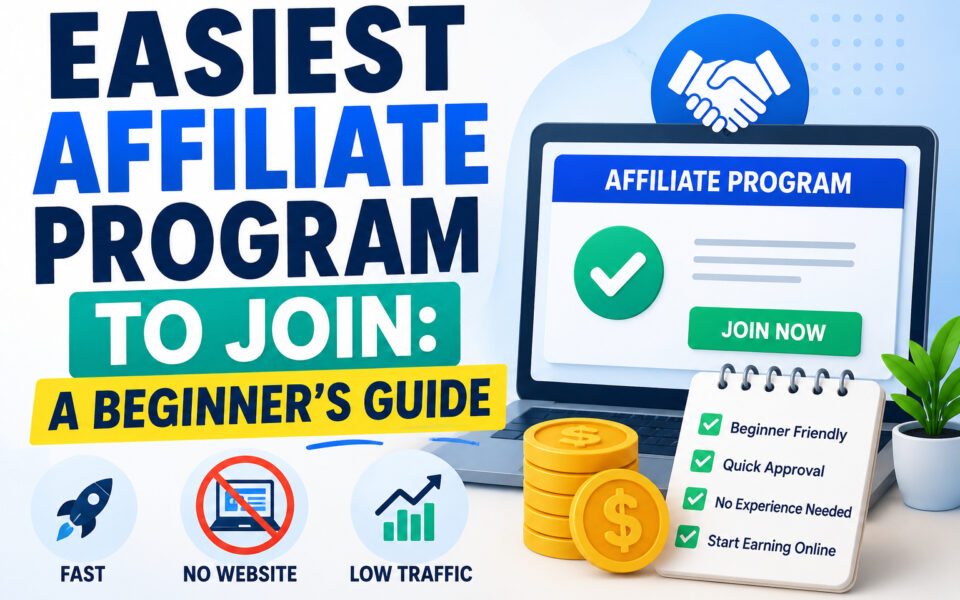
Short answer: there isn’t a single “easiest” affiliate program for everyone — but several programs and networks stand out for beginners because they have quick applications, low traffic requirements, and forgiving rules. Pick the one that matches your platform (blog, social, YouTube, email) and niche, and you can be earning referrals in days — sometimes immediately.
Quick overview: best easy-to-join options
- ClickBank — instant sign-up, lots of digital products, low barrier to entry.
- Amazon Associates — huge product selection, familiar to buyers; quick application but requires a qualifying sale within 180 days.
- eBay Partner Network — straightforward to join, wide range of physical goods.
- ShareASale and CJ Affiliate — large networks with many beginner-friendly merchants; application speed varies by merchant.
- JVZoo, WarriorPlus — instant or fast approvals for digital-product affiliate programs (commonly used by marketers).
What makes an affiliate program “easy” to join?
When readers ask “What is the easiest affiliate program to join?” they usually mean one or more of the following:
- Fast application and approval process (instant or same-day)
- Low or no traffic requirements and relaxed acceptance criteria
- Ability to promote without a website (social media, YouTube, email)
- Simple tracking, clear payouts, and low payout thresholds
- Large product selection so you can find relevant offers quickly
Programs that meet most of these points are the best for beginners. Below we break down practical options and who each one suits.
Best programs for absolute beginners (no website required)
If you don’t have a blog or website yet, these programs tend to accept creators who use social profiles, YouTube channels, or email lists:
- ClickBank — account creation is immediate and you can pick many digital products to promote. Good for creators who can drive traffic from social or email.
- Amazon Associates — you must list your promotional platforms during signup; many social creators and small sites are approved. Note: you need a qualifying sale within the trial period to remain active.
- eBay Partner Network — works for social and video creators, typically straightforward approval.
- JVZoo / WarriorPlus — these are marketplaces for digital offers; approvals are generally fast and sellers often welcome affiliates.
Tip: even when a program allows signups without a site, reading each program’s rules is important. Some merchants disallow certain promotion methods (paid ads or coupon sites, for example).
Easiest affiliate networks to join
Affiliate networks host many merchants. Signing up with a network gives you access to multiple programs through one account. Networks commonly cited as beginner-friendly include:
- ShareASale — many small and mid-size merchants, straightforward signup; merchant approvals vary.
- CJ Affiliate — reputable network with recognizable brands; merchant acceptance rules differ by advertiser.
- Awin — global network; individual advertisers set approval rules but many accept small sites.
- Impact — widely used by SaaS and subscription brands; approvals can be faster if your platform fits the merchant’s audience.
Networks make it easy to browse offers and compare commission structures, but individual merchants can still require info about your site or traffic sources.
Programs with fast or instant approval
If speed is important, consider:
- ClickBank — instant account creation and access to many offers.
- JVZoo / WarriorPlus — fast onboarding for digital products.
- Amazon Associates — quick initial approval; you must make a qualifying sale within the trial period to maintain status.
- Some individual merchants on ShareASale or CJ — many merchants auto-approve affiliates; check merchant descriptions.
Fast approval doesn’t mean easy profits. You still need promotion and conversion strategies.
High-paying affiliate programs that are still beginner-friendly
High commission rates usually come from digital products, software (SaaS), web hosting, and online courses. Many of these programs welcome new affiliates but may require more convincing during application:
- Web hosting (Bluehost, SiteGround, Hostinger, etc.) — high per-sale payouts and simple signup; common recommendation for new bloggers who teach website building.
- Website builders and tools (e.g., some site builders, page builders) — recurring commissions or large one-time payouts for paid plans.
- Online course platforms and software (some use Impact, ShareASale) — often offer sizable commissions for premium products.
Note: some high-paying programs require a website or proof of audience, or they have stricter terms on paid traffic. For most beginners, web hosting affiliates offer the best balance of acceptance and commission size.
Can you join affiliate programs without a website?
Yes. Many programs accept promoters without a site — they’ll ask for the channels you plan to use (social, YouTube, email). That said, having even a small landing page or link-in-bio funnel can improve approval odds and conversions.
Common no-website approaches:
- Short-form social content (Instagram, TikTok) with a link-in-bio linking to an affiliate disclosure and list.
- YouTube videos with affiliate links in descriptions (include a disclosure).
- Email marketing — requires compliance with the program’s rules on email promotion and opt-in consent.
Be transparent. Many merchants will reject or terminate affiliates who do not disclose that their link is an affiliate link, or who bait-and-switch with misleading promotions.
Choosing the easiest program for your situation
Match the program to your platform and goals:
- If you have no website and create short videos: ClickBank, JVZoo, Amazon (if you can show social profiles), and eBay Partner Network are reasonable starting points.
- If you’re a new blogger or small website owner: Amazon Associates, ShareASale, and web hosting affiliate programs are common first choices.
- If you want higher-ticket or recurring revenue: Look for SaaS or hosting programs. These may ask about your audience but often accept new affiliates with good promotional plans.
Step-by-step: how to join and start promoting (quick roadmap)
- Pick a niche and platform. Focus on topics you can consistently create content for — readers prefer helpful, specific recommendations.
- Create a basic promotional presence. This can be a small blog, a Linktree-style landing page, or social profiles with clear descriptions.
- Sign up to an affiliate network or merchant account. Complete the application honestly and list where you’ll promote (site URLs or social handles).
- Choose offers that fit your audience. Relevance beats commission rate for beginner conversions.
- Add links and disclosures. Include a simple affiliate disclosure on your page or video description per FTC guidelines.
- Drive traffic and test what converts. Organic search, social, and email are the typical free channels to start with.
- Track performance and scale. Use the network’s reporting and simple UTM tags to learn which content drives sales.
Common hurdles and how to avoid them
- Application rejections: Fix by providing accurate URLs and a clear description of how you’ll promote. If you don’t have a website, show active social channels and a content history.
- Low conversions: Focus on product relevance and honest reviews/tutorials that answer real problems.
- Policy violations: Read merchant rules about email, paid ads, coupons, and trademark usage to avoid bans.
- Payout thresholds: Check minimum payment amounts and payment methods before relying on a program for income.
Top affiliate programs for beginners — quick comparison
- ClickBank — Pros: instant sign-up, many digital offers, high commissions. Cons: some low-quality offers exist; vet products carefully.
- Amazon Associates — Pros: massive product catalog, easy to explain. Cons: low commission rates on many categories and short cookie life.
- eBay Partner Network — Pros: strong brand recognition and product variety. Cons: varied commissions and slightly different tracking rules.
- ShareASale — Pros: wide range of merchants, easy to browse. Cons: merchant-specific approval and variable terms.
- CJ Affiliate — Pros: big brands and detailed reporting. Cons: some advertisers require established traffic or content quality.
- JVZoo / WarriorPlus — Pros: especially easy for digital-product promotions. Cons: niche buyer base; some products are promo-heavy.
Which should you pick as your first affiliate program?
Consider these starter picks based on your situation:
- New blogger with a small site: Amazon Associates and a web hosting affiliate (if you teach site-building) are common first choices.
- Creator with no site (TikTok, Instagram, YouTube): ClickBank, JVZoo, or eBay Partner Network — and use a link-in-bio with clear disclosures.
- Someone focused on higher income per sale: Hosting or SaaS affiliates — prepare to show how you’ll promote and who your audience is.
There’s no single best program for everyone. Start small, learn what resonates with your audience, and add programs over time.
Extra tips to speed up success
- Pick a narrow niche and target content to solve specific problems. Niche relevance increases trust and conversions.
- Create helpful, honest content: product comparisons, tutorials, and real-use case posts/videos convert better than generic sales pitches.
- Use long-tail keywords and content that matches search intent if you plan to rely on organic traffic.
- Always include disclosures and follow program rules — credibility and compliance matter long-term.
Final answer: What is the easiest affiliate program to join?
If you want a single, practical answer: ClickBank and Amazon Associates are among the easiest programs for most beginners to join quickly. ClickBank offers instant access to many digital offers and low entry friction. Amazon Associates provides unrivaled product variety and broad buyer familiarity; its application is fast, though you must make a qualifying sale during the trial period.
Beyond those two, the right choice depends on your platform and goals. If you need immediate approval and have social reach, ClickBank or JVZoo are good starts. If you’re building a blog or small website, Amazon and major affiliate networks (ShareASale, CJ) are practical next steps.
Start with one program, learn basic promotion and compliance, then expand. The easiest program to join becomes the most profitable when you pair it with consistent, high-quality content and promotion that match your audience.
Want a short checklist to get started?
- Choose one program that fits your platform (ClickBank or Amazon for most beginners).
- Create a minimal promotion page or tidy social profiles with transparent affiliate disclosure.
- Apply, grab links, and publish one helpful piece of content promoting a relevant product.
- Track clicks and conversions, then refine based on what works.
Follow those steps and you’ll move from signup to your first referral much faster than most beginners expect.
More from The Affiliate Digest
-
Tube Claw AI review: Features, pricing, is it legit or a scam?
Tube Claw AI promises an all-in-one AI toolkit for faceless YouTube channels: scripts, voices, avatars, SEO and uploads.…
-
Brett Rutecky’s Affiliate Store Review
Affiliate Store is a low-cost, no-code AI assistant for creating a simple affiliate storefront. It can generate product…
-
How to Get Traffic for Affiliate Marketing: A Beginner’s Step‑by‑Step Guide
Practical, step-by-step methods to get targeted traffic for affiliate marketing — free and paid options, SEO and content…
-
Aigency Valet Review — What Joshua Zamora’s Service Promises and Who It’s Best For
Aigency Valet is a marketing/agency support product marketed by Joshua Zamora that promises systems and assets to help…
-
Vidicom review: AI product videos for e-commerce (2026)
Vidicom is an AI video generator that creates studio-style product videos from a product URL. It’s designed for…