Search is changing. Instead of sending users to pages, many platforms now try to give direct answers: featured snippets, knowledge panels, voice assistants, and in-app answers. Answer Engine Optimization (AEO) is the practice of optimizing content so it appears as those direct answers. While AEO overlaps with traditional search engine optimization (SEO), it emphasizes immediate, concise, and structured responses for human-like question answering.
What is Answer Engine Optimization (AEO)?
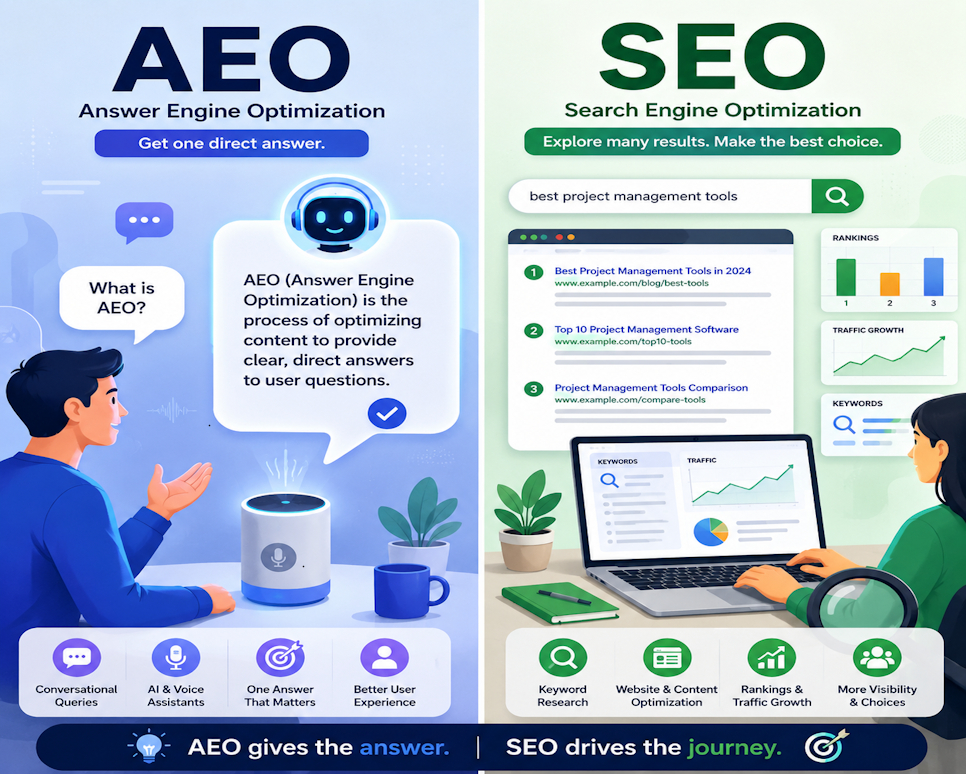
Answer Engine Optimization (AEO) is the process of shaping content so that answer engines — systems designed to return a single, precise response to a query — can find, understand, and present it to users. These answer engines include search features such as featured snippets, knowledge panels, and People Also Ask boxes, as well as voice assistants like Google Assistant, Siri, and Alexa.
AEO is focused on matching the intent of a query and supplying a clear, verifiable answer that an algorithm can extract and display directly, without requiring the user to click through to a web page.
How is AEO different from regular SEO?
SEO and AEO share the same goal — get your content in front of users — but the strategies and priorities differ in several important ways:
1. Outcome: click vs. immediate answer
- SEO: Often aims to improve rankings across many pages, increasing clicks, dwell time, and conversions. The typical endpoint is getting a user to visit your website.
- AEO: Aims to have content displayed as a direct answer (snippet, voice response, or knowledge card). The endpoint may be the answer itself — sometimes without any click.
2. Format and length
- SEO: Long-form pages, pillar posts, and articles that cover topics in depth tend to perform well over time.
- AEO: Concise, explicit answers formatted in short paragraphs, lists, tables, or Q&A pairs are preferred because they are easier for answer engines to parse and present.
3. Structure vs. topical authority
- SEO: Builds topical authority, internal links, and depth so search engines view a site as a go-to resource on a subject.
- AEO: Prioritizes structured data, clear labels (headings), and isolated answer blocks that an algorithm can extract precisely.
4. Signals and measurement
- SEO: Measures success with organic sessions, rankings, backlinks, and conversions.
- AEO: Measures impressions in answer placements, voice-assistant deliveries, and how often content is pulled into featured snippets or knowledge panels — many of which may not lead to direct site visits.
How answer engines find and present answers
Answer engines use a mix of natural language processing (NLP), knowledge graphs, structured data, and ranking signals to select content. Key steps include:
- Understanding intent: identifying whether the user expects a fact, a definition, a how-to, a list, or a comparison.
- Extracting candidate answers: scanning indexed pages to find short passages or structured data that match the intent.
- Verifying reliability: using signals like page authority, schema markup, citations, and historical CTR to decide whether to trust an answer.
- Formatting for presentation: choosing a paragraph, bullet list, table, or media to display in the search results or voice response.
Key AEO ranking factors (how algorithms judge answers)
Answer engines favor content that is:
- Concise and specific: Directly answers the question in a short span, often one to three sentences or a compact list.
- Well-structured: Uses clear headings (H2/H3), Q&A format, lists, tables, or step-by-step instructions that are easy to extract.
- Accurate and authoritative: Comes from a source with topical credibility or verifiable references.
- Marked up with structured data: Schema.org markup (FAQ, QAPage, HowTo, Recipe, Product) helps platforms recognize answerable content.
- Context-aware: Signals such as user location, device, query phrasing, and recent trends affect which answers are chosen.
Practical AEO optimization checklist
Use this checklist to optimize existing content or create new pages with answer-first intent in mind.
- Target specific questions: Identify frequent questions in your niche (use Search Console, People Also Ask, forums, and voice-query data). Build pages or sections that answer a single question clearly.
- Lead with the answer: Put the direct answer within the first 40–60 words or immediately under a question-styled heading.
- Use clear, scannable formatting: Employ short paragraphs, bullet lists, number sequences, and tables for comparison or steps.
- Add schema markup: Implement appropriate structured data types like FAQ, HowTo, QAPage, and Product to help answer engines extract answers.
- Include concise summaries: For long-form content, add a one-paragraph summary or TL;DR that distills the key answer.
- Support answers with citations: Link to credible sources, studies, or official documentation to increase trust and verifiability.
- Optimize for voice: Use natural, conversational phrasing and include short, direct responses that an assistant can read aloud.
- Structure content for extraction: Use question headings (H2/H3) and immediately follow with the short answer to make extraction easier.
- Monitor and iterate: Track featured snippet impressions, clicks, and voice-answer occurrences in Search Console and analytics tools.
Content types that work best for AEO
Not every content format is equally likely to be chosen as an answer. High-performing types include:
- Short definition paragraphs: Clear definitions for “What is X?” questions.
- How-to steps: Compact step-by-step instructions for procedural queries.
- FAQ entries: Frequently asked questions with precise answers.
- Comparison tables: Side-by-side specs for decision queries (A vs. B).
- Lists: Ranked lists or enumerations (e.g., “Top 5 X”).
Structured data and technical tactics
Schema markup is one of the most reliable ways to signal answerable content. Implement the following where relevant:
- FAQPage schema: For pages with multiple Q&A pairs.
- HowTo schema: For procedural content and tutorials.
- QAPage schema: For community Q&A or forum-style content.
- Product, Recipe, and Article schemas: For specialized answer types that frequently appear in search features.
Other technical best practices:
- Ensure pages load quickly and are mobile-friendly — many answer interactions happen on phones or smart speakers.
- Use clear HTML headings so parsers can detect question/answer blocks.
- Expose structured data in the page source (JSON-LD is recommended by search engines).
Voice search and conversational interfaces
Voice queries tend to be longer and more conversational. To prepare content for voice assistants:
- Write in natural language and include common conversational phrasings.
- Provide short, direct answers followed by one-sentence elaborations when needed.
- Favor canonical, authoritative answers that an assistant can cite or summarize succinctly.
Measuring AEO success
Standard SEO metrics (rankings and traffic) matter, but AEO requires additional signals to measure impact:
- Featured snippet impressions: Track via Google Search Console to see how often your content is shown as an answer.
- Voice-assistant interactions: Platform-level reporting is limited, but you can infer performance from branded query volume and click-through changes after optimizing.
- Visibility in People Also Ask and knowledge panels: Use SERP tracking tools to detect when your content appears in these features.
- Change in organic traffic and conversions: Some answer placements reduce clicks but still influence downstream behavior — monitor assisted conversions and branded searches.
Tools that help with AEO
- Search Console — for featured snippet impressions and query data.
- SERP trackers (Ahrefs, SEMrush, Moz) — to identify answer features and track changes.
- People Also Ask explorers and question research tools (AlsoAsked, AnswerThePublic).
- Schema validators and structured data testing tools for technical implementation.
Common mistakes to avoid
- Writing long, meandering introductions instead of placing the direct answer up front.
- Relying solely on long-form content and ignoring scannable answer blocks.
- Over-marking content with irrelevant schema — incorrect schema can confuse engines.
- Optimizing only for clicks — if your goal is conversions, measure downstream effects, not just impressions.
Who should prioritize AEO (and who might skip it)
Prioritize AEO if:
- Your site answers frequent, specific user questions in your niche (help centers, how-to sites, product docs, recipes, finance Q&A).
- You want higher visibility in voice and mobile search results.
- You produce content that benefits from being extracted as short answers (definitions, procedures, comparisons).
Consider deprioritizing AEO-focused work if:
- Your primary goal is long-form brand content or narrative storytelling where clicks and time-on-site are the main KPI.
- Your audience is highly transactional and you prefer controlling conversion pathways through on-site funnels rather than answer placements that may reduce clicks.
Quick AEO action plan (first 90 days)
- Audit top-performing pages and identify questions they already answer; add short answer blocks beneath question headings.
- Implement FAQ/HowTo schema where appropriate and validate with a structured data testing tool.
- Create a prioritized list of high-intent questions from Search Console and People Also Ask; build or add clear answer sections for the top 20.
- Monitor featured snippet impressions and adjust copy and formatting for the best-performing queries.
Final thoughts
Answer Engine Optimization (AEO) complements traditional SEO by targeting the growing class of search experiences that prioritize direct answers over clicks. By focusing on clarity, structure, and verifiability — and by measuring answer placements in addition to traffic — you can capture these high-visibility placements and improve how your content serves users across search, voice, and assistant platforms.
Start small: identify a handful of high-value questions, answer them clearly at the top of the page, add appropriate schema, and track whether your visibility in answer features increases. Over time, AEO can be an important part of a balanced search strategy that includes both long-form authority content and concise answer-first assets.
More from The Affiliate Digest
-
Tube Claw AI review: Features, pricing, is it legit or a scam?
Tube Claw AI promises an all-in-one AI toolkit for faceless YouTube channels: scripts, voices, avatars, SEO and uploads.…
-
Brett Rutecky’s Affiliate Store Review
Affiliate Store is a low-cost, no-code AI assistant for creating a simple affiliate storefront. It can generate product…
-
How to Get Traffic for Affiliate Marketing: A Beginner’s Step‑by‑Step Guide
Practical, step-by-step methods to get targeted traffic for affiliate marketing — free and paid options, SEO and content…
-
Aigency Valet Review — What Joshua Zamora’s Service Promises and Who It’s Best For
Aigency Valet is a marketing/agency support product marketed by Joshua Zamora that promises systems and assets to help…
-
Vidicom review: AI product videos for e-commerce (2026)
Vidicom is an AI video generator that creates studio-style product videos from a product URL. It’s designed for…