- Yes — Adstorm is worth buying if your bottleneck is creating many ad creatives quickly for testing across platforms.
- It’s strongest as a creative-volume tool (copy + visuals + variations), not a guaranteed profit machine.
- Verify pricing, usage limits and commercial-rights at checkout before purchase.
Short answer: Adstorm is worth buying for marketers, ecommerce owners, affiliates, and small agencies that need large volumes of platform-ready ad creatives fast. It speeds up brainstorming, copywriting and asset resizing into one workflow — but it won’t replace strategy, landing-page testing, or ad media buying skill.
What is Adstorm?
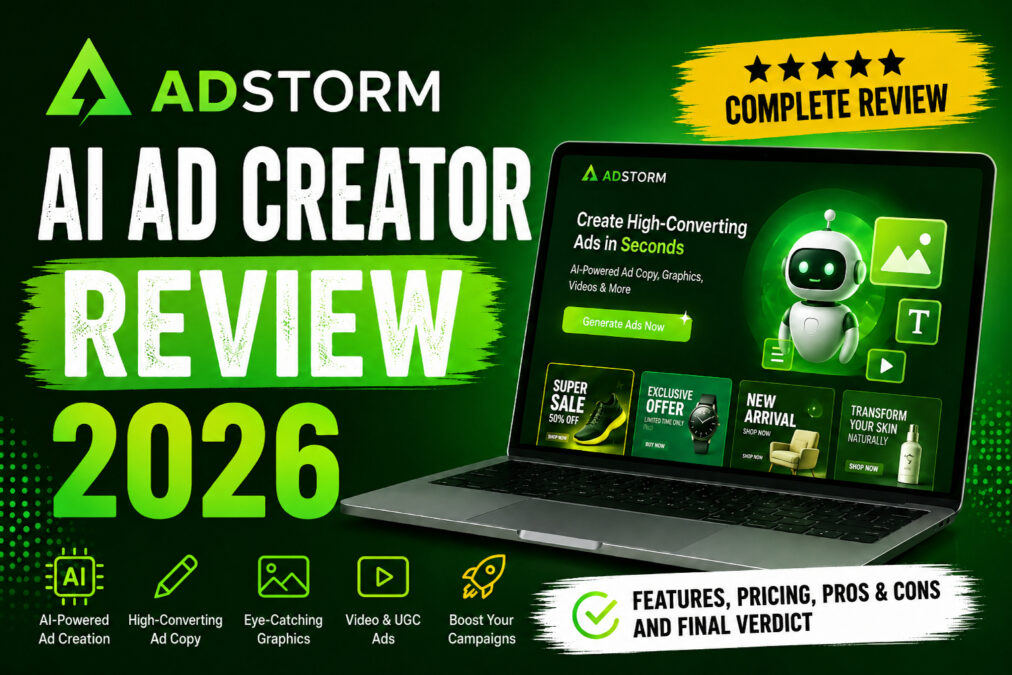
Adstorm is positioned as an AI ad-production platform that generates ready-to-publish ad assets for multiple platforms and ad types. The product claims to produce sets of ad copy, image designs, video ads (including UGC-style clips), and product mockups — and to output platform-specific formats for Facebook, Google, TikTok, YouTube and more so you can test multiple angles quickly.
Who created Adstorm?
Adstorm is offered through the launch and marketing channels commonly used by Teknikforce. If the creator or vendor is a deciding factor for you, check the product checkout and vendor pages for explicit company details and terms before buying.
How does Adstorm work?
Adstorm’s workflow is designed around fast creative production. The basic steps shown on the product pages are:
- Provide a product URL or enter product/service details manually (headline, features, images).
- Choose a target platform and desired ad types (image, text, video, UGC, mockup).
- Let the AI generate multiple angles: headlines, hooks, CTAs, description copy, and design variations.
- Review, tweak, and export platform-ready assets and ad bundles for testing.
The platform advertises URL-based creation (pulling info from a landing page), automated copy + creative pairing, and bulk generation of alternatives so you can test dozens of creatives without waiting on designers.
Key features
Adstorm’s feature list focuses on covering the common creative bottlenecks in paid ads. Notable features include:
- URL-based ad generation: Auto-extracts product/landing-page details to seed ad copy and visuals.
- Platform-specific formats: Templates and sizes for Facebook, Google, TikTok, YouTube, X, Pinterest, Quora, Reddit, LinkedIn and native ad networks.
- Copy + visual pairing: Generates headlines, hooks, CTAs and image/video concepts together instead of separately.
- Image ads and product mockups: Creates static ad visuals and product mockups with logo and asset integration.
- Video ads & UGC-style videos: Produces short video ad drafts and UGC-style clips meant to look organic.
- AI photo editing: Basic photo touch-ups, background treatments, and mockup placements.
- Clone/ad inspiration feature: Use a competitor ad as inspiration to generate original variants (use with legal caution).
- Multiple angles & variations: Bulk-create variations for A/B testing without manual resizing or rewriting.
- Multi-language support & brand assets: Support for multiple languages and ability to upload logos or existing graphics.
- Team & agency features: Campaign organization, multi-user access and agency-oriented workflows are mentioned for client work.
Adstorm pricing (what to know)
Pricing details on the sales pages include an “Elite” plan description with visible limits such as 20,000 welcome credits, up to 10 campaigns, up to 30 ads per campaign, up to 3 UGC videos daily, and up to 10 mockups daily. The pages also show crossed-out standard prices and discounted calls to action.
Important caveats:
- The public sales page sometimes uses images or checkout-specific pricing; live checkout price and any time-limited discounts should be verified before buying.
- Limits for credits, campaigns, UGC videos, mockups and AI options may vary by plan and are worth confirming if you plan high-volume production.
- Look for commercial rights or agency licenses if you intend to sell creatives to clients — the product pages reference agency upgrades but confirm scope and restrictions on the checkout terms.
- Refunds: the official pages show a 30-day refund language, but check the exact refund policy and eligibility criteria at purchase.
What I like about Adstorm
- Speed and volume: It’s built to produce many angles and variations quickly — ideal for creative testing.
- Single workflow for copy + visuals: Combining copywriting with visuals reduces back-and-forth between writers and designers.
- Multi-platform support: Not limited to Facebook — it targets a range of ad networks and placements.
- Beginner-friendly: Templates and automated prompts make it usable for non-designers and non-copywriters.
- Agency-friendly features: Campaign organization and client-ready assets help freelancers and small agencies scale creative delivery.
What I don’t like / limitations
- Marketing claims need testing: Labels like “high-converting” are marketing claims until proven in your own campaigns.
- AI requires human review: Output needs editing for brand voice, policy compliance, and originality.
- Potential legal risks with clone feature: The clone/inspiration tool should be used to adapt ideas, not copy copyrighted creative closely.
- Price and limits can be unclear: Visible crossed-out prices and image-based pricing mean you should verify final cost and limits at checkout.
- Not a replacement for ad strategy: Great creative helps, but tracking, audience targeting, offers and landing pages still determine profitability.
Is Adstorm better than hiring a designer or using Canva?
It depends on your goal:
- If you need a quick stream of test-ready ad variations (copy + visuals) without coordinating multiple freelancers, Adstorm can be faster and cheaper than repeatedly hiring designers and copywriters.
- If you need fully custom, brand-accurate production — high-end motion design or bespoke studio filming — a human creative team will still outperform AI drafts.
- Compared with Canva, Adstorm focuses on ad-specific outputs and automated copy pairing; Canva is stronger as a flexible design editor for custom hand-tweaks. Many users may use both — Adstorm to generate ad concepts, Canva to refine designs.
Who is Adstorm best for?
Adstorm is best for:
- Solo affiliate marketers who need multiple ad variations quickly.
- Ecommerce store owners who launch new products often and need fresh creatives for paid channels.
- Small businesses who can’t afford a dedicated designer and copywriter for every campaign.
- Local marketing agencies and freelancers who need to create client ad samples or scale creative production.
- Content marketers testing offers on Facebook, Google, TikTok, YouTube, Pinterest, or native ad networks.
Who should avoid Adstorm?
- Businesses that expect automatic profitable ads from “push-button” AI — Adstorm won’t fix a weak offer or bad landing page.
- Advertisers who never run paid traffic — this tool assumes you plan to launch ads and test creatives.
- Large media-buying teams with mature creative studios and bespoke workflows — they may prefer full custom production.
Practical buying guidance
If you’re considering Adstorm, use this checklist:
- Confirm live pricing and any trial or discount on the checkout page.
- Verify credit limits, daily UGC mockup caps, campaign/ad caps and how those translate to your expected monthly needs.
- Check the commercial license or agency upgrade if you plan to sell ads to clients.
- Plan to edit AI output for brand voice and platform compliance rather than publishing without review.
- Use Adstorm to increase creative volume, then A/B test using proper tracking, offers and landing pages to measure impact.
Final recommendation
Adstorm is worth buying if your primary problem is the creative bottleneck — you need many ad variations quickly for testing across platforms. It combines copy and creatives into one workflow and supports multiple ad types (images, videos, mockups, UGC-style clips), which can save time and reduce freelancer costs.
Do not buy expecting guaranteed profitable campaigns. Treat Adstorm as a productivity tool for creative volume: use it to accelerate idea-to-ad pipelines, then validate with disciplined testing, tracking, and landing-page optimization.
Pros and cons (summary)
| Pros | Cons |
|---|---|
|
|
FAQ
Can Adstorm create Facebook, Google, TikTok and YouTube ads?
Yes. The product pages list templates and output formats for Facebook, Google, TikTok, YouTube and several other platforms, making platform-specific ad sizes and copy recommendations.
Does Adstorm create both copy and graphics?
Yes. A core selling point is generating paired copy (headlines, hooks, CTAs) with visual assets and ad-sized variants in one workflow.
Does Adstorm make video ads and UGC videos?
Adstorm advertises short video ad generation and UGC-style clips. These are typically AI-generated drafts that you should review and edit for brand alignment.
Can Adstorm create product mockups and edit product photos?
Yes. It includes mockup generation and basic photo-editing capabilities for placing products into ad layouts or mockup scenes.
Can Adstorm generate ads from a website URL?
Yes. URL-based generation is a mentioned feature: the AI pulls product/landing-page information to seed ad copy and visuals.
Can Adstorm clone competitor ads?
Adstorm provides an inspiration/clone feature to recreate the style or angle of competitor ads. Use this carefully: adapt ideas rather than copying copyrighted material or violating ad platform policies.
Does Adstorm support multiple languages and brand assets?
Yes — multi-language support and logo/asset uploads are included to help keep ads on-brand in different markets.
Is Adstorm suitable for agencies and freelancers?
Yes. It targets freelancers and small agencies who need to produce ad creatives for clients quickly; agency upgrades and commercial license options are referenced but verify specifics at checkout.
Do I need design or copywriting skills to use Adstorm?
No. The platform is designed for non-designers and non-copywriters. However, some editing skill and ad strategy knowledge improve final results.
How many campaigns and ads can I create?
Plan limits vary by plan. The visible Elite plan example lists up to 10 campaigns and up to 30 ads per campaign; confirm limits on the live checkout for your intended usage.
How much does Adstorm cost? Monthly or one-time?
Pricing and billing options change frequently on launch-style product pages. The sales page shows Elite Monthly and Elite Yearly references, but live checkout pricing and discounts should be verified before purchase.
Does Adstorm offer a refund?
The official pages show 30-day refund language. Confirm the exact refund policy and any conditions directly on the checkout page.
Does Adstorm include commercial rights?
Commercial/agency rights are mentioned but may require an upgrade. Confirm license terms at checkout if you plan to sell ad creatives to clients.
Affiliate disclosure
This is an affiliate review. If you choose to buy Adstorm via links originating from this review, we may earn a commission at no extra cost to you. We only recommend products we believe can help the intended users — in this case, people who need faster ad creative production. Always verify pricing, limits, and license terms at checkout before purchasing.
- Adstorm is worth considering if your bottleneck is ad creative volume rather than strategy.
- It speeds up copy + creative pairing and supports many ad types, but verify pricing, limits and commercial rights before buying.
More from The Affiliate Digest
-
Tube Claw AI review: Features, pricing, is it legit or a scam?
Tube Claw AI promises an all-in-one AI toolkit for faceless YouTube channels: scripts, voices, avatars, SEO and uploads.…
-
Brett Rutecky’s Affiliate Store Review
Affiliate Store is a low-cost, no-code AI assistant for creating a simple affiliate storefront. It can generate product…
-
How to Get Traffic for Affiliate Marketing: A Beginner’s Step‑by‑Step Guide
Practical, step-by-step methods to get targeted traffic for affiliate marketing — free and paid options, SEO and content…
-
Aigency Valet Review — What Joshua Zamora’s Service Promises and Who It’s Best For
Aigency Valet is a marketing/agency support product marketed by Joshua Zamora that promises systems and assets to help…
-
Vidicom review: AI product videos for e-commerce (2026)
Vidicom is an AI video generator that creates studio-style product videos from a product URL. It’s designed for…